Purpose Protected.
Legacy Preserved.
A governance framework for the Volta Sovereign Community Campus — defining the interests that cannot be overridden and the mission that must endure.
The Volta Charter is not designed to create another layer of management. It is designed to prevent the wrong layer of management from ever overriding the mission.
The campus is being established through a dedicated SPV. But the SPV alone does not define the project's long-term purpose. The Charter establishes the principles intended to protect the interests of the founding partner, the community, the beneficiaries, and future generations — including defined protected matters that cannot be changed unilaterally.
At its centre is a proposed Golden Vote / reserved governance mechanism — a structural safeguard designed to protect the fundamental mission of the campus beyond the life of any single operator, investor, or board.
The charter framework — at a glance.
Click to enlarge
The Charter exists to protect everyone involved.
Five distinct interests are recognised within the Charter framework — each with defined protections against unilateral alteration.
The Community
The Volta region community — the people for whom the campus is built. Their access to education, skills and vocational infrastructure is a protected purpose of the campus, not a discretionary output.
The Beneficiaries
Current and future beneficiaries of campus programmes. The Charter is intended to prevent any future governance change from redefining or restricting who the campus serves.
The Founding Principal
The partner who commits the anchor capital and establishes the model. Their founding role, recognition and defined rights within the governance framework are protected matters.
The SPV & Operators
The operational entity that builds and runs the campus. The Charter provides clarity on what the SPV can and cannot change — protecting operational flexibility while constraining mission drift.
Future Generations
The campus is designed to be permanent and self-sustaining. The Charter is intended to ensure that what is built cannot be dismantled, repurposed or privatised by future boards or interests.
What cannot be changed unilaterally.
These matters require a supermajority or Golden Vote to alter — they cannot be changed by ordinary board resolution or majority vote alone.
A structural safeguard, not a veto.
Inspired by governance mechanisms used by the world's most enduring mission-driven institutions.
The Golden Vote Mechanism
The proposed Golden Vote is a reserved governance right that activates only when a protected matter is subject to change. It is not a day-to-day operational control — it is a constitutional safeguard.
Under the proposed structure, any resolution that would alter a protected matter — including the campus mission, beneficiary rights, or the founding partner's defined position — requires either unanimous consent or the exercise of a reserved voting right that cannot be overridden by ordinary majority.
The SPV operates the campus. The Charter protects its purpose.
This is not a new concept.
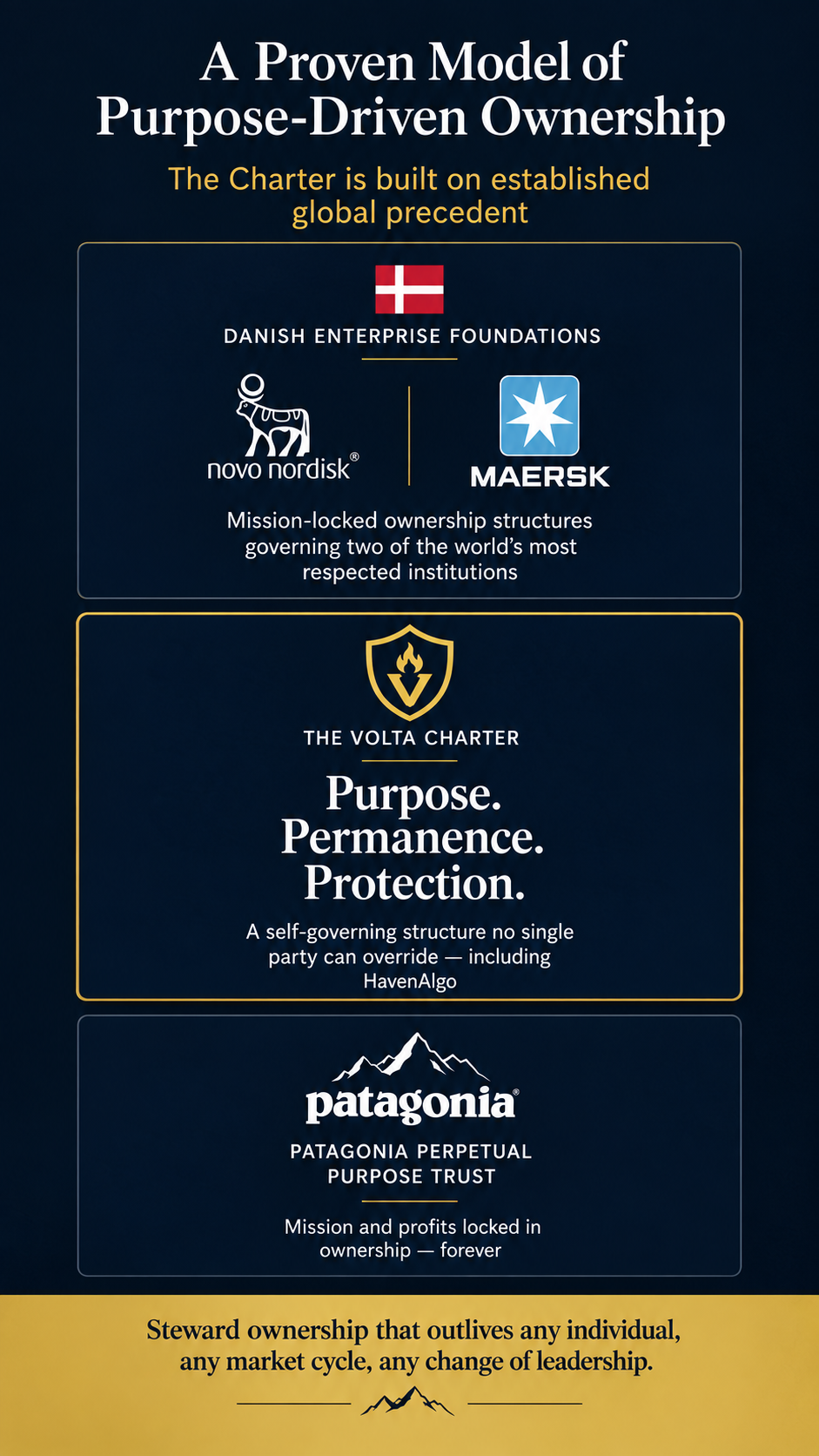
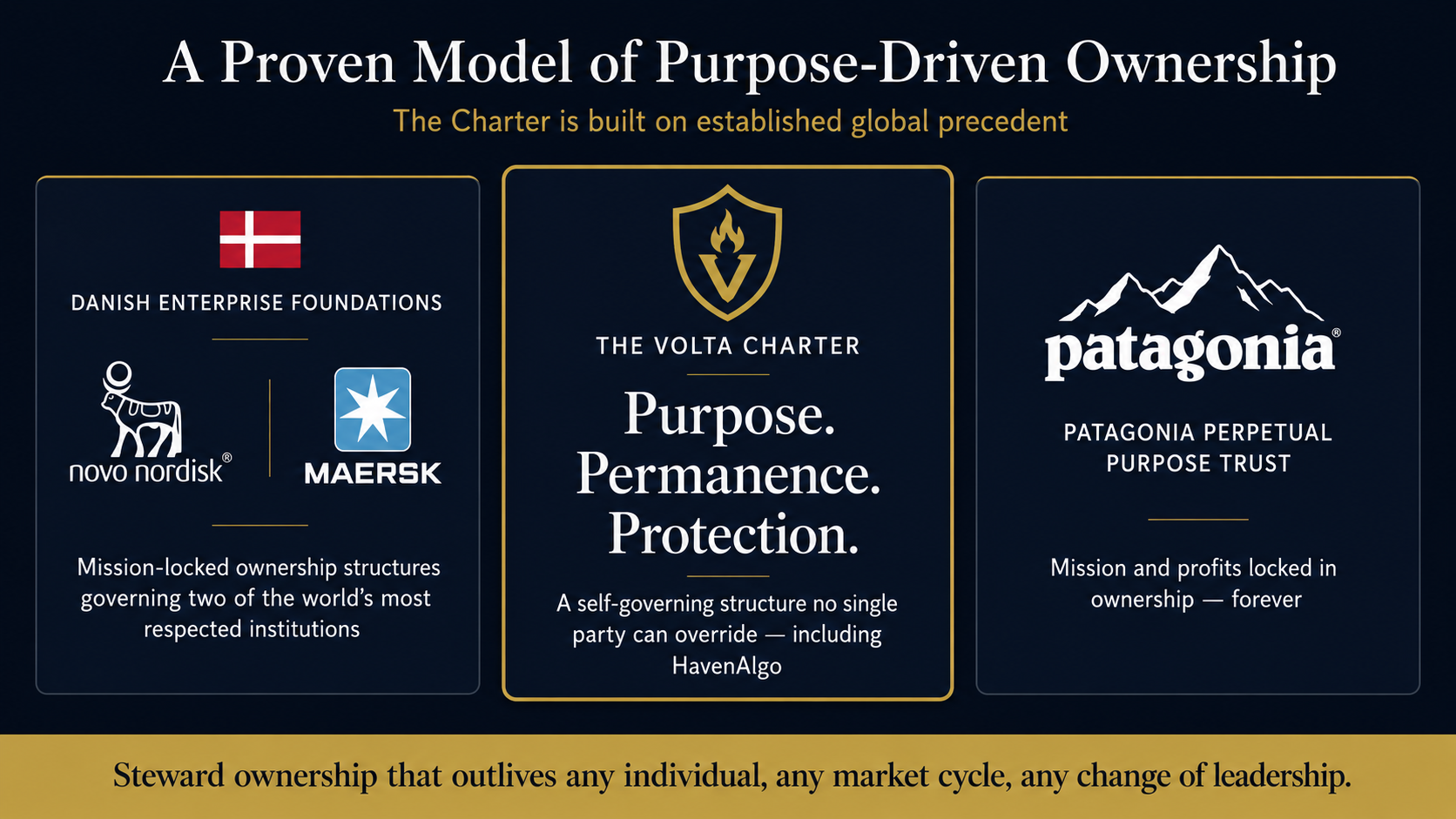
The world's most durable institutions use constitutional governance mechanisms to protect their purpose. The Volta Charter draws on these established models.
Combines commercial stability with scientific, humanitarian and social purposes through Articles of Association containing voting and constitutional mechanisms that explicitly preserve founding intent. Governance principles emphasise checks and balances and prevention of undue influence by any individual or board.
One of the world's largest charitable foundations, established with a constitutional governance structure that prevents the mission from being altered to serve commercial or private interests — regardless of future board composition.
A mission-driven institutional framework operating across 30+ countries, with governance architecture explicitly designed to protect programme continuity and beneficiary access irrespective of political or commercial pressures.
Reserved voting mechanisms used in the privatisation of national infrastructure to protect public interest matters from majority shareholder override — a constitutional precedent directly applicable to mission-critical governance.
Foundation structures in German-speaking jurisdictions are legally required to preserve the founding purpose. The Stiftung model is the institutional precedent for permanent, mission-protected capital deployment at scale.
Ghana's constitutional framework provides mechanisms for embedding reserved rights and protected purposes within SPV and institutional charters — providing direct local legal precedent for the Volta Charter governance structure.
A note on legal form: The precise mechanism by which the Charter is embedded — whether through constitutional provisions, reserved matters, special voting rights, a Golden Share structure, or another instrument — will be determined by the founding partner's Ghanaian legal counsel. The Charter defines the principles. The legal architecture implements them.
Return to the campus.
Request a founding call.
The data is verifiable. The programme milestones are defined. The governance framework is documented. One principal-to-principal conversation from there.