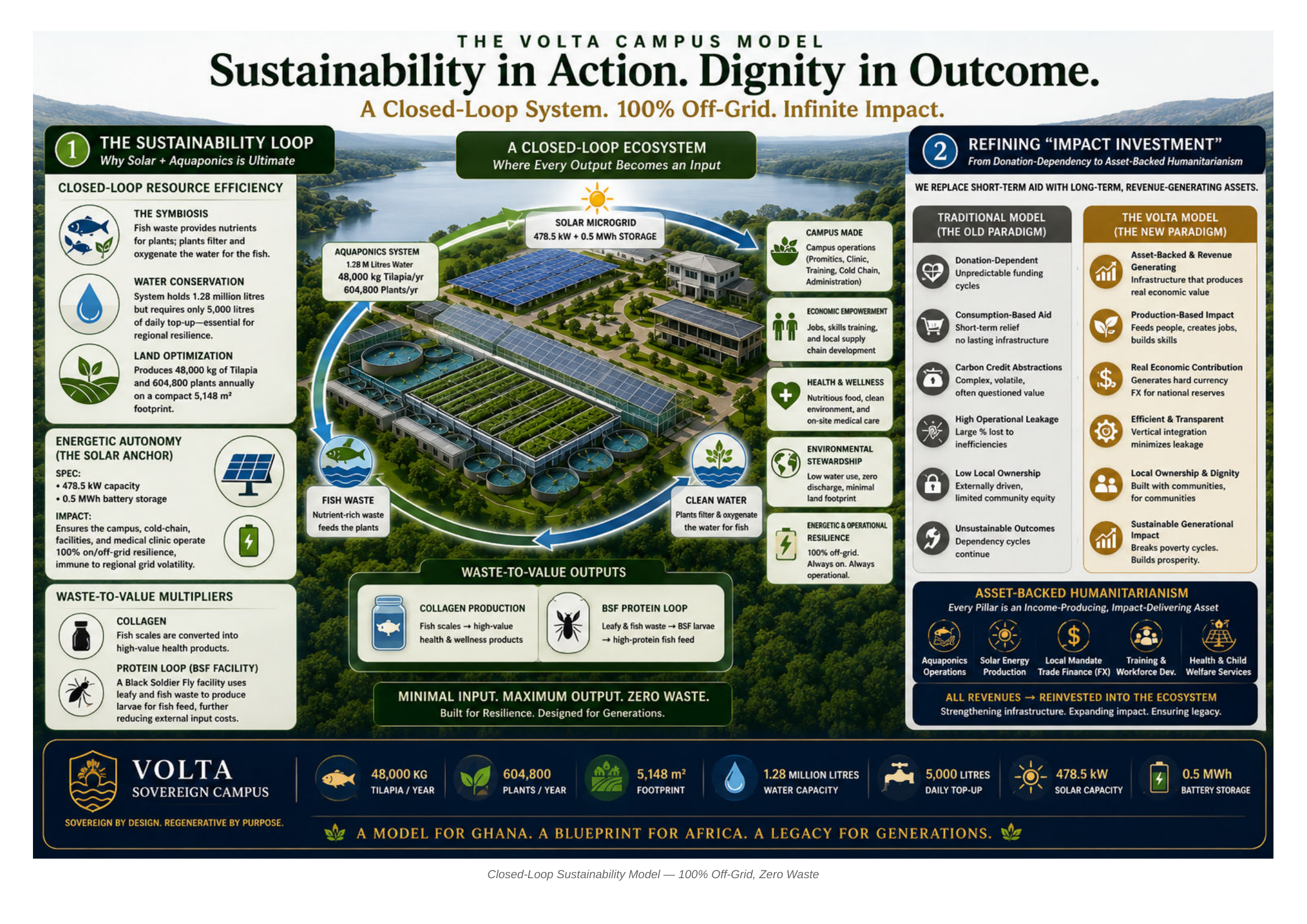
The Volta Sovereign Campus — closed-loop ecosystem, 100% off-grid, zero waste · enlarge ↗
There is a moment that everyone in humanitarian and development finance has encountered, even if they don't name it precisely. A programme ends. The funding cycle closes. And the infrastructure that was built — the school, the clinic, the water system, the training centre — begins to deteriorate within months. Not because the community doesn't value it. Not because the need has disappeared. But because the funding has.
The standard response to this is to seek more funding. Longer grants. Larger endowments. Better pipeline management. Multi-year commitments. These are reasonable responses. They are also, in most cases, wrong diagnoses.
The problem is not the quantity of money. The problem is that the infrastructure was designed from the outset to require perpetual external support. The economics of its operation were never meant to close without a donor at the table. Nobody built it to sustain itself. And because nobody built it to sustain itself, it doesn't.
The question is not "how do we fund this forever." It is "why did we design something that needs to be funded forever?"
What self-financing looks like from the start
A project designed for financial sovereignty looks different at every stage of planning. It begins with a different question — not "what is our funding model?" but "what is our operating model, and does the revenue generated by that model cover our costs?" These sound similar. They are structurally opposite.
In the first framing, funding is the input and delivery is the output. In the second, delivery generates return and the financial structure is subordinate to operations. The institution becomes the principal. Capital serves the mission, rather than defining the constraints of it.
This is not an abstraction. It changes which land is acquired, how buildings are specified, what energy systems are chosen, which economic activities are embedded in the infrastructure from day one, and how community participation is structured legally and commercially. A closed-loop system — one where food production, energy generation, employment, and service delivery are all woven together — looks and costs very differently from a collection of separately funded facilities.
The decisions that matter are made before ground is broken
After three years working on humanitarian infrastructure deployment in West Africa — specifically in Ghana's Volta Region — the pattern that matters most is not execution quality. Execution can be improved. What cannot easily be undone is the structural premise on which a project is founded.
An office operational for two years, a supply chain already in place, land locations identified, local leadership embedded in the ownership structure — none of these things happen at the point of delivery. They are the result of decisions made years earlier about what the institution is supposed to become. Whether it is designed to depend on a funder, or designed to outlast one.
The two models produce different buildings, different governance documents, different cash flow projections, different community relationships. And critically, they attract different kinds of capital. Grant capital flows toward dependence, because grant-giving requires ongoing dependency to justify its own existence. Patient, equity-structured, or systematically-financed capital can flow toward sovereignty — but only if sovereignty was the design intent from the start.
The conversation that is still missing
The most sophisticated foundations, DFIs, and family office impact teams I have encountered are not naive about this. They understand that aid dependency is a structural problem. Many are actively searching for models that break the cycle.
What is still rare is a frank architectural conversation at the point of inception — before a project is designed, before capital is committed, before governance documents are written. A conversation that asks not "how will we fund this?" but "how will this fund itself, and what does the architecture need to look like for that to be true?"
That conversation produces a different kind of institution. One that doesn't need another grant.